
There’s a tendency in post-growth thinking to assume the global affluent are somewhat homogeneous. A study on global values reveals strong divergence, even in a modernising and globalising world, with the greatest divergence around emancipatory values. This has implications for advocating sustainability to affluent people around the world.
Researchers Joshua Conrad Jackson and Danila Medvedev have charted how global values are diverging across national cultures over time. Their results contradict predictions that globalisation and increasing national income would normalise adoption of Western values around the world. Values of self-expression and tolerance diverge the most, separating high income Western nations from the rest of the world. Geographic proximity correlates with similarity of values. Global divergence, local convergence.
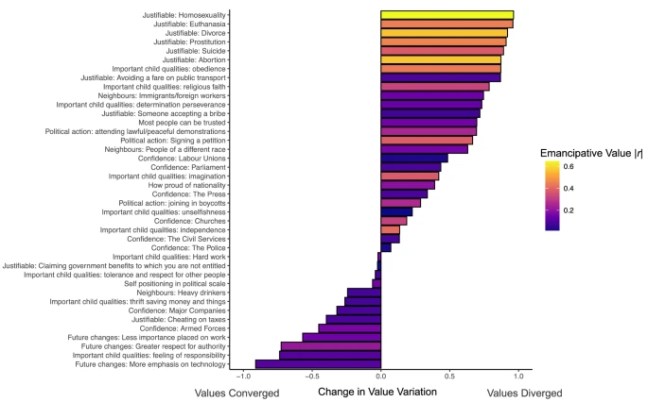
The paper’s examination of Western, Educated, Industrialised, Rich and Democratic (WEIRD) countries highlights not the dominance, but rather the peculiarity, of their social mores against a global backdrop of emerging geopolitical regionalism. The rich West has become secular, but affluent Arab nations are maintaining their religiosity.
Study authors, Joshua Conrad Jackson and Danila Medvedev, point out that for the social sciences, the importance of inclusivity, non-Western methodologies, reflexivity and representative datasets could not be clearer, in order to produce valid theories and conclusions.
What resonates with me is the limitation these findings suggest of Western-centric approaches to global challenges, such as the COP approach to climate action and the Davos business ideal.
It also highlights to me that building political support for a shift away from the excesses of affluent lifestyles mustn’t assume only the individualistic, emancipatory values of the Western rich, but a diversity of value sets among affluent societies across regions.
A way forward is to work with common values but also recognise multiple modernities and the situational risks and opportunities each represents for transitioning to a lower metabolism global economy.
Feature image by Serge Kutuzov on Unsplash.
 Heliocene