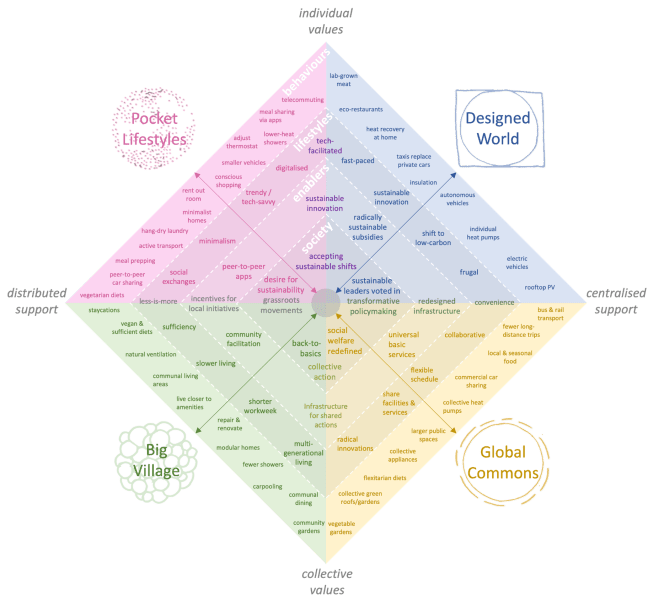
Narratives properly explaining the various approaches to sustainable lifestyles have been missing from climate modelling. Now, European researchers have developed the SLIM (Sustainable Living in Models) scenarios, offering four lifestyle narratives for long-term climate mitigation, designed to be easily incorporated into Integrated Assessment Models (IAMs).
Previously, IAMs have used simplified assumptions (e.g. 100% vegan diets) that don’t reflect diverse actions and aren’t informative for policymakers about various lifestyle changes for climate mitigation.
The research team, Nicole van den Berg, Andries Hof, Vanessa Timmer, Lewis Akenji and Detlef Van Vuuren, has quantified two SLIM scenarios, Pocket Lifestyles and Designed World, using SSP2 ‘Middle-of-the-Road’ as a reference for 2050, finding that lifestyle changes can contribute substantially to climate change mitigation.
Pocket Lifestyles reduce emissions through consumption changes like teleworking, sustainable transport and smaller homes. Designed World focuses on technology-enabled changes like electric vehicles, peer-to-peer taxi services and home insulation.
Compared to the SSP2 reference in 2050, Pocket Lifestyle reduces transport emissions by 12 % (0.17 Gt CO2) in Global North and 27 % (1.15 Gt CO2) in Global South, and residential emissions by emissions by 9 % (0.17 Gt CO2) in Global North and 8 % (0.39 Gt CO2) in Global South.
Designed World reduces passenger transport CO2 emissions by 51% (0.7 Gt CO2) in the Global North and 40% (1.7 Gt CO2) in the Global South, and residential emissions by 21% (0.39 Gt CO2) in the Global North and 6% (0.31 Gt CO2) in the Global South.
A combination of SLIM scenarios could potentially lead to higher emissions reductions, but this has not yet been modelled. Only transport and residential emissions have been modelled so far. Future research could also explore other changes, such as food-related behaviour.
 Heliocene