
Housing has become an expensive asset and a key pillar of capitalism, where profitability reigns—leaving some people in substandard homes or without a home at all. Instead, the building industry needs to see itself as part of a system for provisioning shelter—satisfying a human need—rather than a developer of housing as an asset. This shift is part of a larger policy change where several key sectors are being re-imagined as provisioning services: the building industry to provide shelter, the transport industry to provide accessibility and mobility, the manufacturing industry to provide clothing and appliances, and the food industry to provide nutrition – with infrastructure underpinning them all.
Housing: a key pillar of capitalism
Real estate holds more global wealth than any other asset class, with residential property making up three quarters and growing in value by 21 percent from 2019 to 2022 (Tostevin & Rushton, 2023). Building floor area is expected to double by 2060 (UNEP, 2024). It’s thought that decarbonising the built environment could generate US$1.9 trillion in new business globally by 2035 (McKinsey, 2022). Yet, under growth settings, renewable energy, resource efficiencies and carbon removal cannot promise absolute reductions in environmental impacts due to the rebound effect (Brockway et al., 2017; Parrique et al., 2019). For instance, the EU economy grew US$1.2 trillion between 2015 and 2021, while its circularity rate increased just 0.4 percent (European Court of Auditors, 2023; World Bank, 2023).

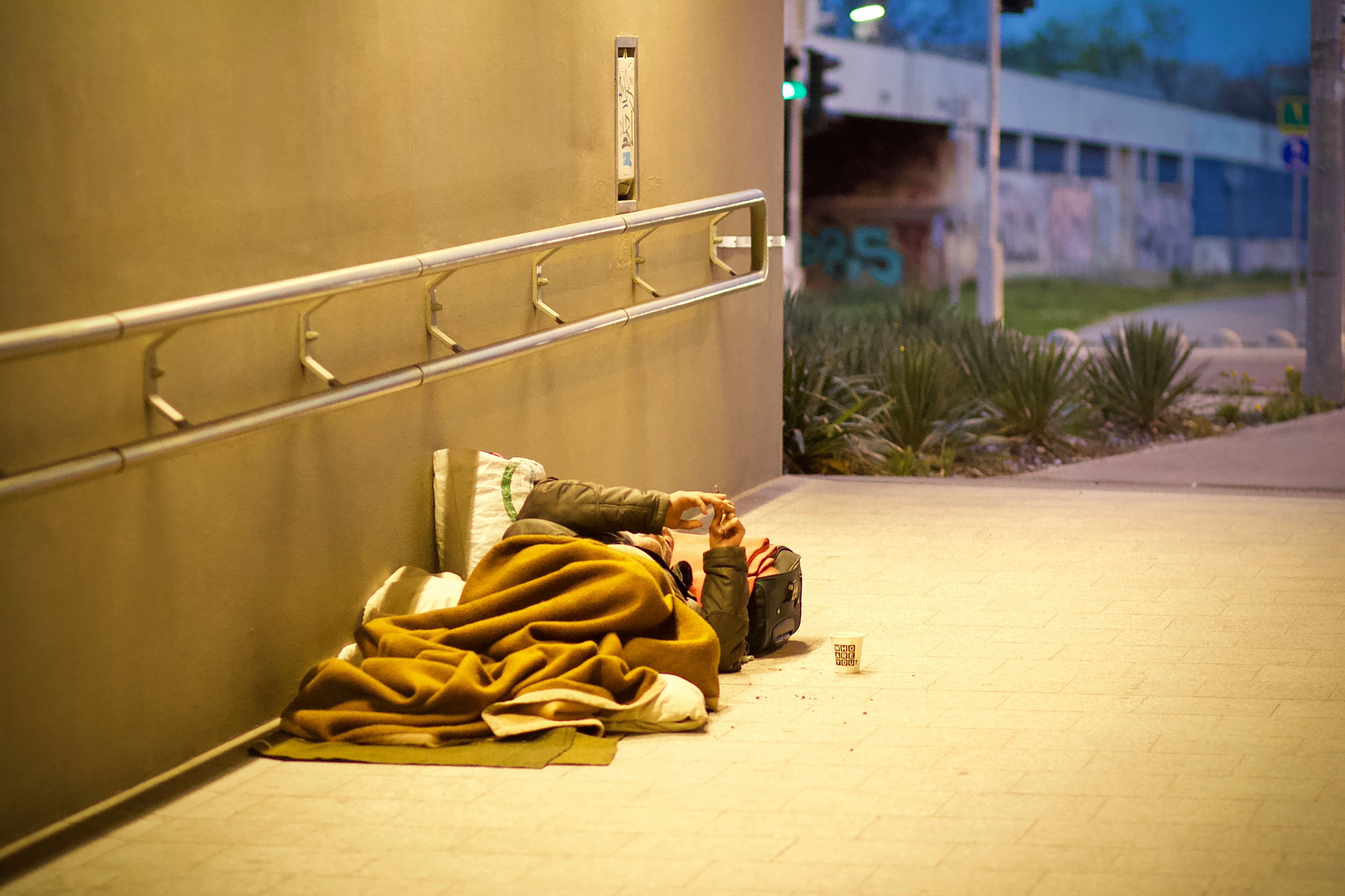
Image of house made of dollars by Kostiantyn Li on Unsplash; image of person living with homelessness by Mihaly Koles on Unsplash.
Moreover, focusing on market growth and supply-side solutions to climate change ignores wellbeing, a non-negotiable clause in a sustainable economy. Housing has become a key pillar of capitalism by becoming an expensive asset (Savini & Bossuyt, 2022). This contributes to homelessness, affecting 1.8 billion people worldwide (UN-Habitat, n.d.). Adequate housing is a human right (Universal Declaration of Human Rights, 1948) that the sector is failing to meet.
Reimagining the building industry
To address these issues, the building industry needs to see itself as a system for provisioning shelter, a human need, rather than a developer of housing as an asset. This shift is part of a larger policy change where several key sectors are being reimagined as provisioning services: the building industry to provide shelter, the transport industry to provide accessibility and mobility, the manufacturing industry to provide clothing and appliances, and the food industry to provide nutrition – with infrastructure underpinning them all (Creutzig et al., 2018; IPCC, 2023). This perspective involves ecological, technological, institutional and social actors working together to use resources to meet human needs (International Resource Panel, 2024).
Sufficiency: a new policy approach
A key global challenge is how to provision equitably, above a minimum delivery for human wellbeing but below a maximum impact on planetary health. The concept of sufficiency describes reducing consumption by the affluent as needed for ecological balance and increasing it where needed for a dignified life (International Resource Panel, 2024).
Decent Living Standards suggest how much is enough for wellbeing using modern technologies. For example, a four-person household would need a minimum floor space of 15 m2 per capita, 2,500 lumens for 6 hours per day, 50 litres of water per capita per day with 20 litres of water heating, and 80kg of household laundry per year (Millward-Hopkins et al., 2020). Future technological improvements could further expand these possibilities (Schlesier et al., 2024).
This level of provisioning would raise the living standards of several billion people, achieving a global social foundation. On the flip side, it is a challenge for those accustomed to a materialistic lifestyle to sufficiently reduce their resource and energy use to enable Earth systems to return within safe Planetary Boundaries.
Degrowth: a transition framework
Business, regulators and citizens need to align on a single transition framework towards provisioning and consuming in line with sufficiency. Degrowth offers this, advocating a planned reduction of energy and resource use to rebalance the economy with the environment, while addressing inequality and improving wellbeing (Hickel, 2021).
Degrowth-aligning businesses differ from the mainstream idea of sustainable businesses. The latter are standalone entities supplying to a competitive market, delivering financial and ESG performance, often maximising profits for shareholders. From a provisioning perspective, satisfying the financial wants of a limited number of people appropriates value out of provisioning (Fanning et al., 2020).
Degrowth-aligning businesses transition their governance and financing structures from appropriation to provisioning mode, collaborate across the provisioning system, optimise their contribution to systemic wellbeing and recognise absolute resource limits. More specifically, they deprioritise profit, adopt participatory governance, explore alternative ownership structures and rethink their strategy, size and scope (Hinton, 2021). Degrowth-aligning businesses are trailblazers, setting a new normal.
Reviving traditional values
Degrowth is not simply a shrinking the economy. It involves rethinking how to provision more with less, reviving traditional values like sharing, solidarity, caring and autonomy. These value shifts can guide and engage the building industry as it moves towards a sufficiency perspective.
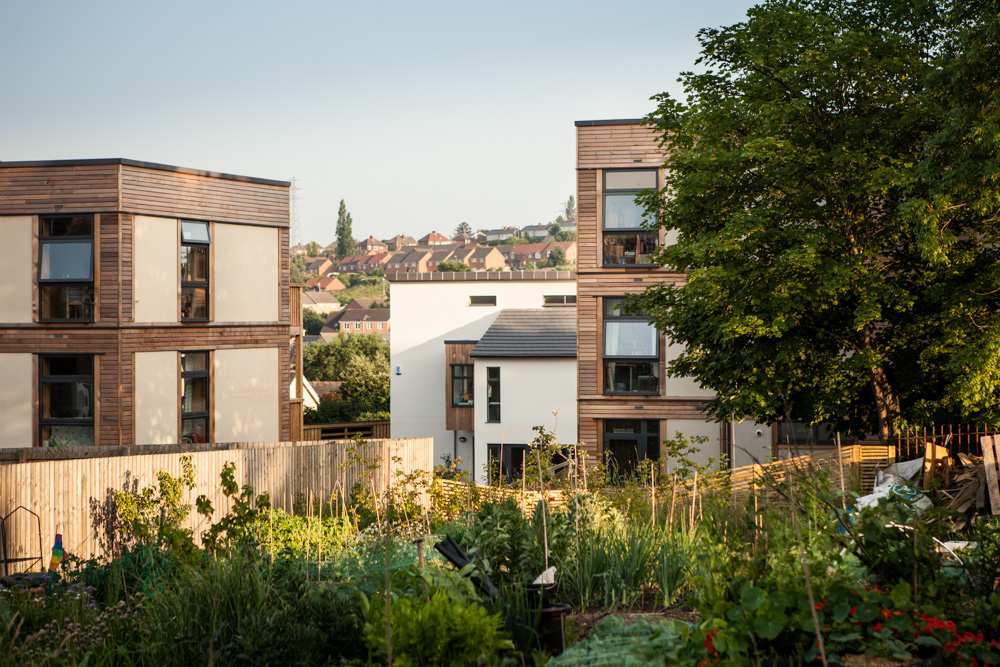
Co-housing at LILAC UK (low impact living affordable community) – image by Andy Lord.
- Sharing encourages communal spaces in buildings, reducing the resource and energy use and floorspace per person. It also promotes the social use of vacant buildings.
- Solidarity builds collective action to reshape housing policies in support of those excluded by the market, protecting renters’ rights and enabling housing cooperatives and community land trusts.
- Caring demands multigenerational homes and intergenerational neighbourhoods with access to green spaces.
- Autonomy calls for shared housing governance and diverse forms of tenure and ownership. It also leads communities to manage their own housing collectives, energy systems, food production, community meals, tool sharing, car sharing and time-banking. Degrowth housing as a policy goal decouples the concepts of home and neighbourhood from property and individualism by de-financialising and de-commodifying property (Nelson & Schneider, 2019; Schmid, 2024).
These same values can help ensure a just transition for workers, too.
- Sharing of knowledge, facilities, tools and other resources can enhance workforce capability and efficiency.
- Solidarity through inclusive decision-making and collective bargaining can ensure workers’ rights and fair wages.
- Caring prioritises worker wellbeing, not only in terms of safety, but also reasonable hours and support systems.
- Autonomy empowers workers with control over their work and environment, while cooperative business models enable distributed decision making and a stake in enterprise success.
Seizing the opportunity
The Danish building industry faces inevitable disruption that could lead to various plausible futures. The best opportunity is to change by design, guided by degrowth principles and values towards sufficiency. To ‘degrow’, the Danish building industry should focus on three key changes:
First, reconfigure as a shelter provisioning system, developing capabilities to deliver decent living standards, rejecting projects aligned with individual excess and supporting those aligned with community autonomy.
Second, agree to use resources and energy within sufficiency levels determined by building life-cycle impacts.
Third, raise sufficiency levels by continually innovating technologies that reduce building life-cycle impacts across all Planetary Boundaries.
Why is degrowth the best opportunity?
A degrowth approach towards provisioning with sufficiency reduces dependence on finite resources and international logistics, helping restore ecological balance and achieve climate goals while improving industry resilience to economic fluctuations. As global resource demand increases, regulations will inevitably seek to decelerate growth. A degrowth-aligned industry will lead by example and benefit from incentives for real progress, such as early achievement of science-based targets and eradication of homelessness. Opportunities will arise to displace laggards to bring provisioning solutions to new communities, working with new partners and driving socially-optimal, resource-minimal innovations.
Providing shelter in balance with nature is a timeless proposition for humanity.
This could establish the Danish building industry as an employer of choice, attracting workers keen to make an impact, maintaining motivation and reducing turnover. As other industries also gravitate toward degrowth, networks of like-minded collaborators will emerge, furthering social and technological innovations. The finance industry will increasingly support degrowth-aligned operations to align with its own sufficiency objectives and degrowth values, to protect wealth in resilient investments amid increasing threats.
The risks of not adopting a degrowth approach are clear. As society experiences more climate and nature damages, social tipping points draw closer and the Overton window shifts toward politically mandated regulation of industry impacts. A building industry that has not adopted sufficiency as a strategy will lose opportunities to deliver on vital projects and face increasing compliance costs due to resource and energy over-use. A reluctance to move beyond growth-reliant models will lead to rising resource prices, supply uncertainty and waste costs, resulting in higher capital costs and financial destabilisation. An inability to meet community needs with higher levels of efficiency will squeeze enterprises out of collaboration networks and potentially out of business. In particular, larger players inadequately addressing their social and environmental responsibilities could damage the whole industry’s reputation, eroding license to operate for all but the clearest front runners. It is in the industry’s interest to move forward together.
Providing shelter in balance with nature is a timeless proposition for humanity. The Danish building industry will not be alone in this radical transformation, but it is currently leading the way. It can influence other industries and countries through ambition and example, inspiring global shifts towards a future filled with possibilities.
References
Brockway, P. E., Saunders, H., Heun, M. K., Foxon, T. J., Steinberger, J. K., Barrett, J. R., & Sorrell, S. (2017). Energy Rebound as a Potential Threat to a Low-Carbon Future: Findings from a New Exergy-Based National-Level Rebound Approach. Energies, 10(1), Article 1. https://doi.org/10.3390/en10010051
Creutzig, F., Roy, J., Lamb, W. F., Azevedo, I. M. L., Bruine De Bruin, W., Dalkmann, H., Edelenbosch, O. Y., Geels, F. W., Grubler, A., Hepburn, C., Hertwich, E. G., Khosla, R., Mattauch, L., Minx, J. C., Ramakrishnan, A., Rao, N. D., Steinberger, J. K., Tavoni, M., Ürge-Vorsatz, D., & Weber, E. U. (2018). Towards demand-side solutions for mitigating climate change. Nature Climate Change, 8(4), 260–263. https://doi.org/10.1038/s41558-018-0121-1
European Court of Auditors. (2023). Special report 17/2023: Circular economy. http://www.eca.europa.eu/en/publications/sr-2023-17
Fanning, A. L., O’Neill, D. W., & Büchs, M. (2020). Provisioning systems for a good life within planetary boundaries. Global Environmental Change, 64, 102135. https://doi.org/10.1016/j.gloenvcha.2020.102135
Hickel, J. (2021). What does degrowth mean? A few points of clarification. Globalizations, 18(7), 1105–1111. https://doi.org/10.1080/14747731.2020.1812222
Hinton. (2021). Five key dimensions of post-growth business: Putting the pieces together. Futures, 131, 102761. https://doi.org/10.1016/j.futures.2021.102761
International Resource Panel. (2024). Global Resources Outlook 2024: Bend the Trend – Pathways to a liveable planet as resource use spikes. United Nations Environment Programme. https://wedocs.unep.org/20.500.11822/44901
IPCC (Ed.). (2023). Demand, Services and Social Aspects of Mitigation. In Climate Change 2022—Mitigation of Climate Change (1st ed., pp. 503–612). Cambridge University Press. https://doi.org/10.1017/9781009157926.007
McKinsey. (2022, November 2). Accelerating green growth in built environment. https://www.mckinsey.com/capabilities/operations/our-insights/accelerating-green-growth-in-the-built-environment
Millward-Hopkins, J., Steinberger, J. K., Rao, N. D., & Oswald, Y. (2020). Providing decent living with minimum energy: A global scenario. Global Environmental Change, 65, 102168. https://doi.org/10.1016/j.gloenvcha.2020.102168
Nelson, A., & Schneider, F. (Eds.). (2019). Housing for degrowth: Principles, models, challenges and opportunities. Routledge.
Parrique, T., Barth, J., Briens, F., Kerschner, C., Kraus-Polk, A., Kuokkanen, A., & Spangenberg, J. (2019). Decoupling debunked – Evidence and arguments against green growth as a sole strategy for sustainability.
Savini, F., & Bossuyt, D. (2022). Housing commons as a degrowth planning practice. In F. Savini, A. Ferreira, & K. C. Von Schönfeld, Post-Growth Planning (1st ed., pp. 35–48). Routledge. https://doi.org/10.4324/9781003160984-5
Schlesier, H., Schäfer, M., & Desing, H. (2024). Measuring the Doughnut: A good life for all is possible within planetary boundaries. Journal of Cleaner Production, 448, 141447. https://doi.org/10.1016/j.jclepro.2024.141447
Schmid, B. (2024). Urban Degrowth. In L. Eastwood & K. Heron (Eds.), De Gruyter Handbook of Degrowth (pp. 233–250). De Gruyter. https://doi.org/10.1515/9783110778359-017
Tostevin, P., & Rushton, C. (2023, September 20). Total Value of Global Real Estate: Property remains the world’s biggest store of wealth. Savills Impacts. https://www.savills.com/impacts/market-trends/the-total-value-of-global-real-estate-property-remains-the-worlds-biggest-store-of-wealth.html
UNEP. (2024, March 7). Not yet built for purpose: Global building sector emissions still high and rising. UN Environment. http://www.unep.org/news-and-stories/press-release/not-yet-built-purpose-global-building-sector-emissions-still-high
UN-Habitat. (n.d.). Housing Rights | UN-Habitat. Retrieved 19 May 2024, from https://unhabitat.org/programme/housing-rights
World Bank. (2023). World Bank Open Data. World Bank Open Data. https://data.worldbank.org
Featured image by Freepic.
 Heliocene