
The current global economic growth model is increasingly at odds with the environmental and climate realities we face. Tackling climate change in growth settings will inevitably result in nature losses, which are not being adequately accounted for—a recent BCG report being a prime example. Climate change solutionism generates false optimism, perpetuating the idea that economic growth can continue without significant environmental consequences.
The BCG report Landing the Economic Case for Climate Action with Decision Makers, March 2025, suggests that investing around 2% of cumulative GDP this century into mitigation and adaptation will resolve economic damages from climate change. But the report fails to acknowledge the macro-critical impacts of economic growth on society and nature and the resulting economic fallout.
Imagine no climate damages going forward. BCG adopts this ideal as a counterfactual (see chart below, highest line). This uses the IPCC WGIII assumption of global GDP growth of 2.5%-3.5% per year from 2019–2050, and 1.3%-2.1% per year from 2050–2100. Simplifying this to an average 3% growth from 2019 to 2050 (2.427 times growth) and an average 1.7% growth from 2050 to 2100 (2.312 times growth), the global economy would be 5.62 times larger by 2100. (The BCG report does not reveal this mulitple.)
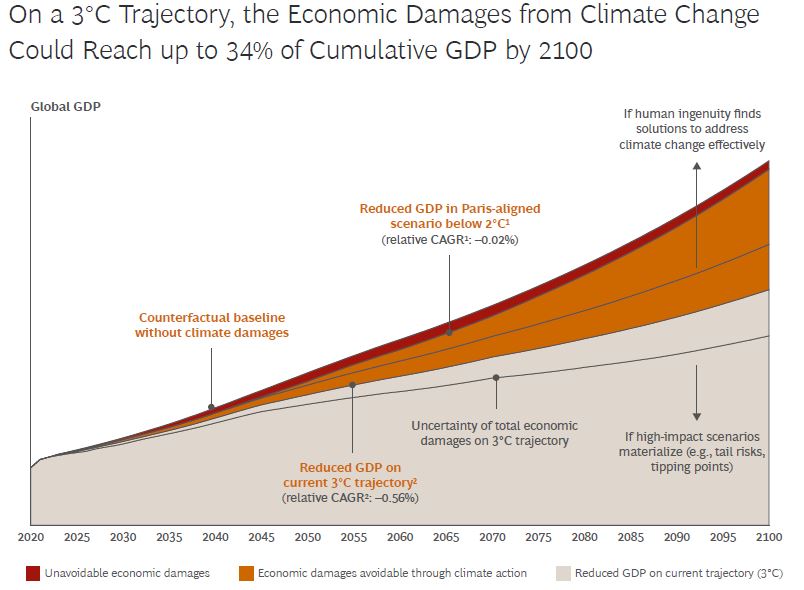
The best-case scenario—limiting warming to 2°C, in line with the Paris Agreement—would result in a 4% GDP loss compared to the ideal, leading to a 5.39 times larger economy by 2100.
However, with the expected trajectory of reaching 3°C warming by 2100, economic damages are projected to reduce GDP growth by 0.56% annually. This results in a cumulative 34% loss, with the economy growing only 3.72 times larger by 2100 compared to 2019.
BCG suggests committing 1-2% of cumulative GDP to mitigation and 0.3% to adaptation by 2100. However, the real cost of resolving climate change is hidden, because an economy 5 times larger requires 3 to 5 times today’s levels of materials use—which would be highly destructive to nature.
Even the most optimistic sustainability scenarios, like those from the UNEP International Resource Panel, project economic growth driving increased resource use, leading to at least two-thirds of the biodiversity loss seen under business-as-usual (BAU). This would cause extensive economic damages. Water-related risks threaten 7-9% of global GDP, mostly hitting manufacturing. Agriculture alone faces 14-18% losses due to water risk and 12% from pollinator decline, according to Oxford University.
The conclusion is clear: mitigating climate change may spur growth in certain sectors, but overall, it must be balanced by contraction elsewhere to meet global goals for nature. The current economic model is not designed for such contraction, which traditionally leads to recession and suffering. A new economic model is needed—one that addresses climate change, nature loss and human wellbeing simultaneously.
Photo by Meggyn Pomerleau on Unsplash
 Heliocene