Brief insights from Jennifer Wilkins

A post capitalist business world may be key to a sustainable economy
Public policy in New Zealand, as in other rich nations, is directed by capitalist interests. The public, however, is increasingly realising that capitalist interests do not align with those of society and nature. Can corporate sustainability and sustainable finance institutions make the switch from representing capitalism to helping businesses evolve…
Keep reading
Moving beyond growth, a critical step to post growth
António Guterres says the world’s accounting systems should move ‘Beyond GDP’ to place true value on the environment by complementing GDP with other indicators, helping governments and the public assess whether GDP growth is truly improving human wellbeing, advancing equity, and safeguarding sustainability now and for future generations. As Jason…
Keep reading
Businesses need stability; capitalism creates chaos
Double materiality between climate and business is deepening in real time. A scan of past headlines tells of rising public awareness of climate and nature issues, failing action and a capitalism increasingly unfit for the challenges it faces. If trends continue, businesses will be negatively impacted by chaos and will…
Keep reading
Prosperous economic activity, not growth
Every time you read, write or begin to say the phrase “economic growth”, swap it out for the phrase “economic activity”. It will cause you to think differently about what is being suggested. You’ll ask: economic activity involving whom, using what, doing what, to create what, to achieve what, for…
Keep reading
A Post-Growth Nature-Positive Aotearoa
An Oct 2024 report by EY NZ and WWF NZ, A Nature Positive Aotearoa, argues that a rapid, major boost to nature protection would contribute to long-term net GDP growth. However, there’s much in the report to support further thinking through a degrowth/post growth lens. NZ is in crisis with…
Keep reading
The Ill Logic of Addressing Climate Change to Save Growth While Growth Destroys Nature
The current global economic growth model is increasingly at odds with the environmental and climate realities we face. Tackling climate change in growth settings will inevitably result in nature losses, which are not being adequately accounted for—a recent BCG report being a prime example. Climate change solutionism generates false optimism,…
Keep reading
Post-Growth Science Explained
The timing could not be sweeter for a new paper—Post-growth: the science of wellbeing within planetary boundaries—from the leaders of post-growth thinking, providing an overview of the current research. With concerns rising that economic growth in high income nations is not sustainable, socially beneficial or even economically achievable, post-growth research…
Keep reading
A Change in Building, By Design
Housing has become an expensive asset and a key pillar of capitalism, where profitability reigns—leaving some people in substandard homes or without a home at all. Instead, the building industry needs to see itself as part of a system for provisioning shelter—satisfying a human need—rather than a developer of housing…
Keep reading
NZCCBC24: Reflections through a Post-Growth Lens
The New Zealand Climate Change and Business Conference is targeted at business professionals working on climate issues. I was invited to present a post-growth economics and enterprise perspective in a panel on A Thriving Economy Within Planetary Boundaries. There was a flurry of social media posts during the conference, all…
Keep reading
We Need Degrowth Energy Scenarios
Degrowth responds directly to climate change and other sustainability and wellbeing issues, affecting energy and resource use. It is crucial not to overlook it when developing climate scenarios for the energy sector. The Aotearoa New Zealand Ministry of Business, Innovation and Employment (MBIE) has released Electricity Demand and Generation Scenarios,…
Keep reading
The Huge Water and Energy Costs of AI
Sustainability reports from Google and Microsoft indicate they are struggling on climate action, with both companies citing expansion of data centres for AI, which have high energy and water demands, coupled with a scarcity of renewable energy. Is AI so profitable they are willing to forego environmental goals? Or do…
Keep reading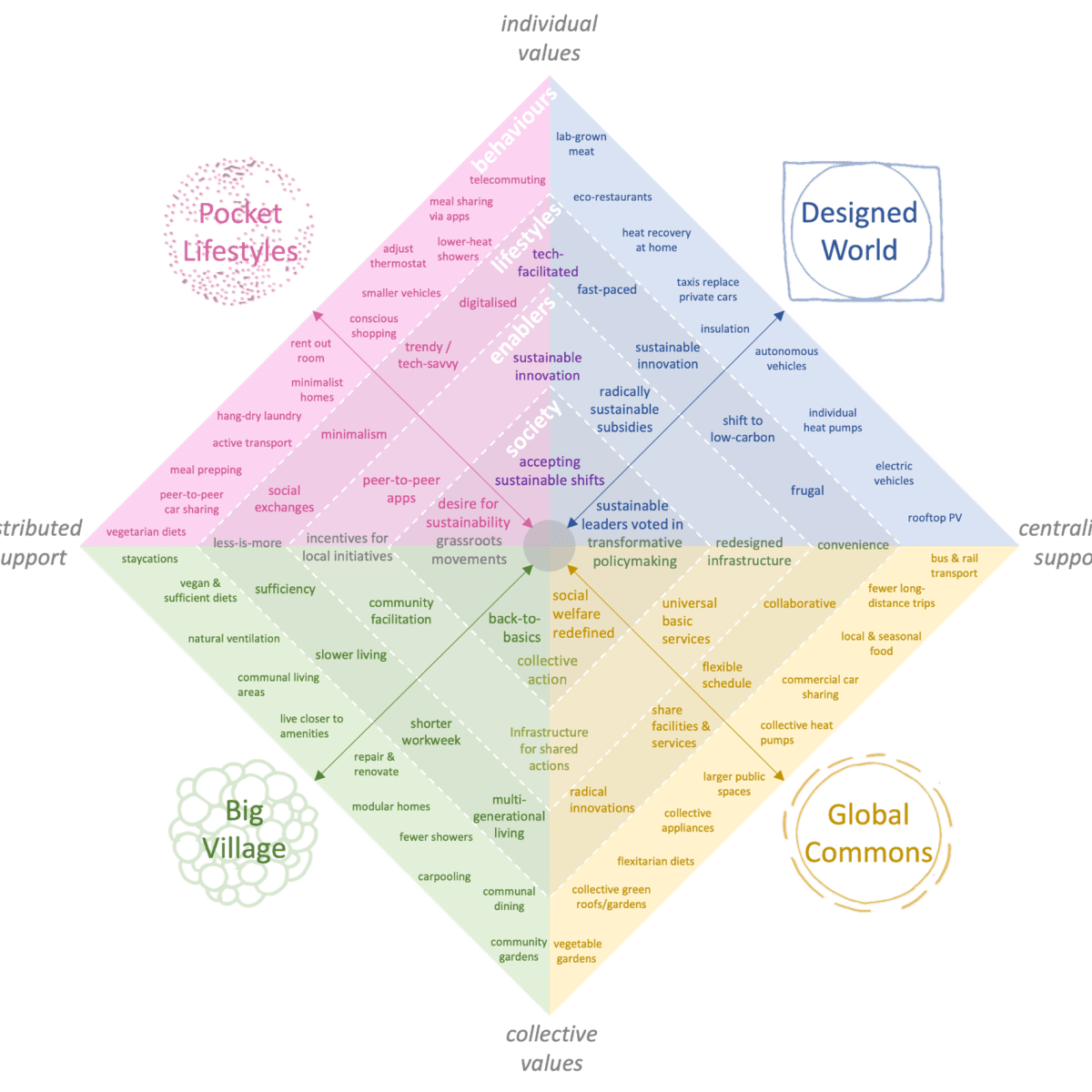
SLIM Lifestyles: Narratives for Climate Models
Narratives properly explaining the various approaches to sustainable lifestyles have been missing from climate modelling. Now, European researchers have developed the SLIM (Sustainable Living in Models) scenarios, offering four lifestyle narratives for long-term climate mitigation, designed to be easily incorporated into Integrated Assessment Models (IAMs). Previously, IAMs have used simplified…
Keep reading
The Heterogeneity of Affluence
There’s a tendency in post-growth thinking to assume the global affluent are somewhat homogeneous. A study on global values reveals strong divergence, even in a modernising and globalising world, with the greatest divergence around emancipatory values. This has implications for advocating sustainability to affluent people around the world. Researchers Joshua…
Keep reading
Oh, Girona!
Ground-breaking news on two fronts: Girona is the first city in Spain to explore degrowth AND a master’s of degrowth programme is going to be delivered alongside the municipal administration. An agreement has just been signed between the City Council, the University of Girona, Dark Matter Labs and Research &…
Keep reading
Growth is No Longer an Answer
In her recent address to the Auckland Business Chamber titled “Growth is the Answer”, New Zealand Finance Minister Nicola Willis acknowledges low-growth projections, imploring businesspeople to lean in on the government’s growth agenda. However, this fails to grasp the essence of entrepreneurship, which is rooted in autonomy. Entrepreneurs are never…
Keep reading
A Survey of Perceptions of Degrowth in the European Parliament
A survey of MEPs by degrowth scholars Giorgos Kallis, Riccardo Mastini and Chritstos Zografos has uncovered some interesting data on opinions, shedding light on the growth dependency within institutions, such as the European Parliament, that makes them resistant to change, despite preferences for change within. Their paper in Nature describes…
Keep reading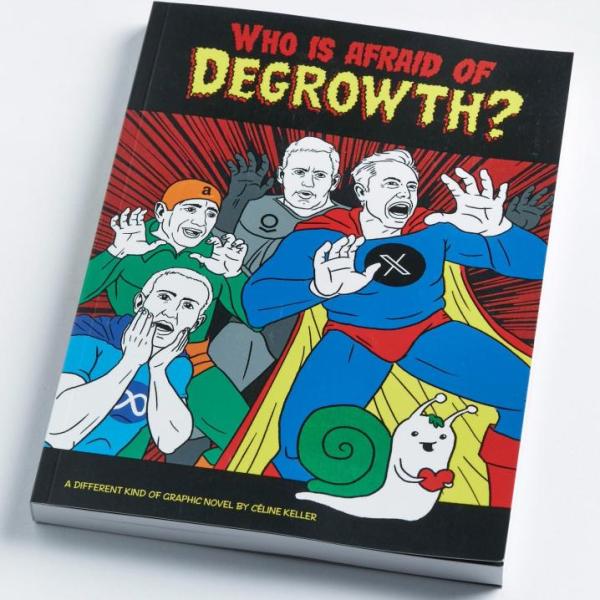
Who is afraid of Degrowth? A brilliant graphic book by Céline Keller
There is so much to love in this graphic book by Céline Keller smashing the myths about degrowth, filled with quotes from the who’s who of both growth and degrowth worlds, juxtaposing their views and really exposing the absurdity of many of the ideas that are taken for granted and…
Keep reading
Setting Limits to Growth: a handbook for post-growth start-ups
“Setting Limits to Growth” is a new handbook for aligning start-ups and SMEs with post-growth thinking, based on a self-case study of its writers’ own business, Post Growth Guide, a post-growth-aligned start-up educating about post-growth business. How’s that for meta! Post Growth Guide (PGG) dovetails with founders’ other business, an…
Keep reading
Who’s Publishing Business Degrowth Research?
The nascent trans-disciplinary topic of business degrowth must find a home where it can cross-pollinate to form new strands of management scholarship. Much of the literature in the field of degrowth lands in the Journal of Cleaner Production. But degrowth business management literature needs to land where business scholars can…
Keep reading
De Gruyter Handbook of Degrowth
A rich, new tome on degrowth has just been published. Congrats to the eds and authors, some of whom I truly admire. But I have a big concern. Searching the book for the words ‘business’ and ‘enterprise’ to see how the authors tackle these, it appears that the degrowth community’s…
Keep reading
Post-Growth Infrastructure: Let The People Decide
Infrastructure decision making needs to flow from community decision makers to financiers, not the other way round. Direct democracy models must ensure that communities have access to a diverse array of experts, including futurists in touch with realistic scenarios around sufficiently meeting the basic needs of future generations and the…
Keep reading
Rethinking the Global Sustainability Agenda
Let’s think about the sustainability agenda and goals such as eradicating hunger and poverty. Are they the right goals? By focusing on the effects, are we ignoring the causes and therefore the alternatives that we could be building? An article in Nature (4 July 2023) has pulled together some of…
Keep reading
Welcome to Degrowth Max Rashbrooke
Max Rashbrooke is a public intellectual in New Zealand, regularly commenting on issues of inequality, wealth, poverty, taxation and democracy. With his 6 May 2023 article on degrowth in Stuff, he appears to have dipped his toe into the waters of degrowth and found them not quite inviting enough to…
Keep reading
A 4-Step Plan for a Post Growth-Ready New Zealand
There is a plausible future in which economic growth is too hard – or undesirable – and is dropped as a economic goal. Instead, distributive and regenerative factors would be emphasised in business and policymaking to enhance wellbeing and nature as new economic priorities. Economics would become socio-ecological. You might…
Keep reading
IPCC Gives Mainstream Economics A Free Pass
The IPCC report, issued on 20 March 2023, is an invaluable synthesis of climate science; however, there is a fundamental issue with IPCC reports in general. They communicate climate science using language that is also used by mainstream economists, such as modelling, equilibrium, financial flows, market barriers, leverage, costs and…
Keep reading
Cool the Extraction Jets
If only our politicians and media were as fixated with wellbeing and environmental growth on a quarterly basis as they are with financial growth. If only we had an environment governor who could intervene to “cool the jets” on materials extraction, waste and pollution in the way our Reserve Bank…
Keep reading
Degrowth-Oriented Value Creation
An important new paper on degrowth-oriented business value creation has just been published. We all understand how businesses create value in the growth paradigm – business models organise activities to enable strategies of efficiency, expansion and innovation to create products and services that increase material and financial wealth for stakeholders.…
Keep reading
New Zealand’s Growth Nostalgia
New Zealanders’ enduring relationship with GDP growth as an economic goal is nostalgic, traceable to the 1960s and a fall in the price of wool. Growth goals have reflected who we are as a nation. We are strivers through thick and thin. Looking forward, however, GDP growth would be misplaced…
Keep reading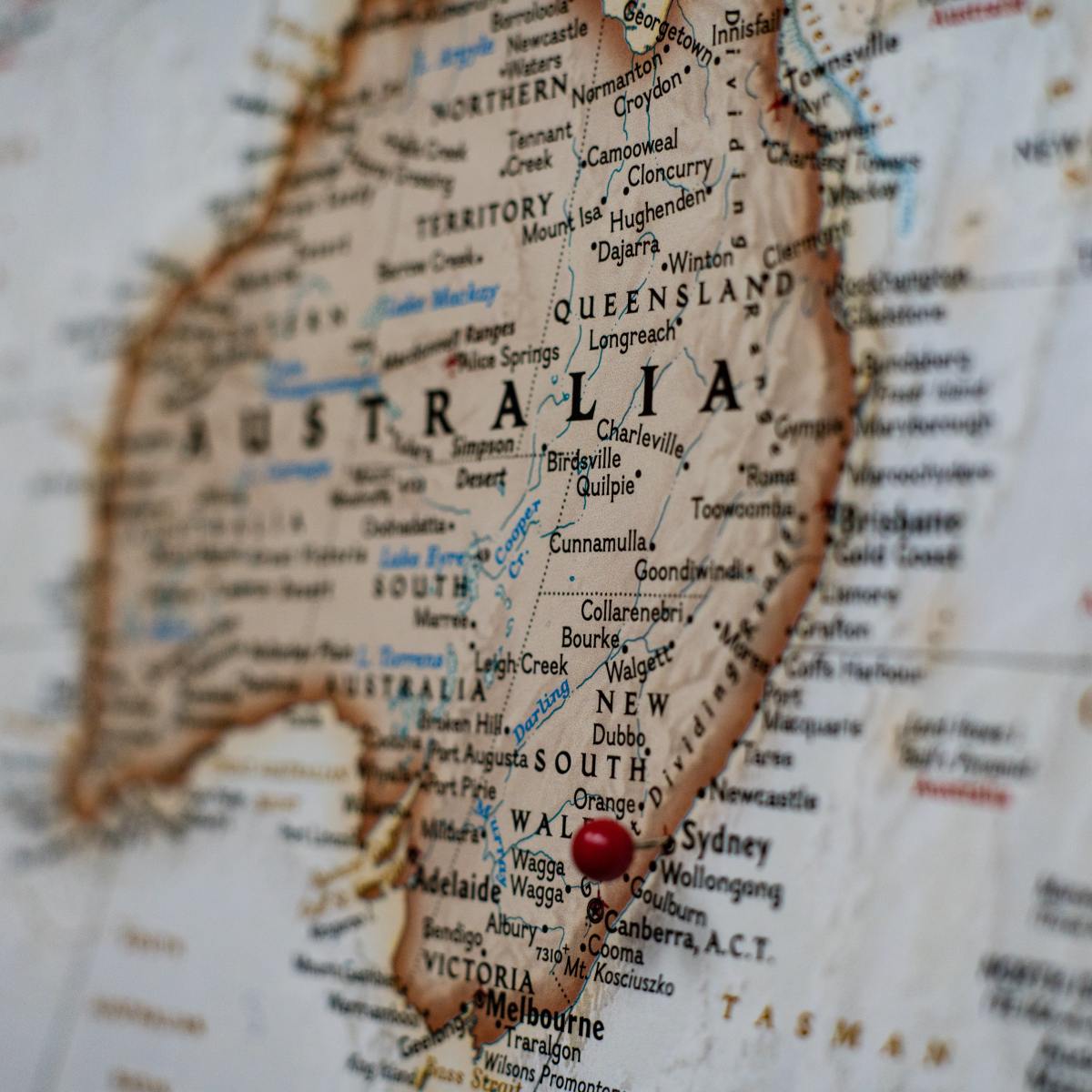
If the Market and the State Cannot Provide Affordable, Sustainable Housing in Australia, Perhaps ‘Housing for Degrowth’ Can.
Having access to adequate housing is a human need and human right. Everyone deserves to have a home. In Australia, residential buildings are provided either by the market as private housing or by the state as social housing. Yet, modest income households are falling into a gap between them. Furthermore,…
Keep reading
Review: Underland by Robert Macfarlane
In this first ever guest post for Heliocene, New Zealand writer Frances Palmer presents a deeply inquisitive review of Underland by Robert Macfarlane. Reaching into its text and its subtexts, she compels us not only to read the book but, more importantly, to understand why it has been written. Macfarlane,…
Keep reading Heliocene