Great to speak to a packed room at the 2024 NZ Climate Change and Business Conference for a kōrero on “A Thriving Economy Within Planetary Boundaries”. Below is my 4-minute speech, which focused on the X-curve to move away from status quo economics towards an eco-social future economy, and the role of degrowth thinking in co-forming that pathway.
Speech and slides begin:
Kia ora koutou katoa. Ko Jennifer Wilkins tōku ingoa. Hello, everyone. I’m Jennifer Wilkins.
I’m an independent researcher in post-growth economics and an advocate for informed discussions about degrowth, which is part of new economics.
New economics is driving a radical social and ecological transition in society and the business context. I’ll describe a framework for visualising this transition and a bit more about degrowth.
We need to see the status quo at the macroeconomic scale. The commonly accepted economic vision is universalised eco-modernism, which is widespread achievement of a technologically advanced, decarbonised Western lifestyle.
There are a number of economic assumptions that underpin the policy agenda for this vision.
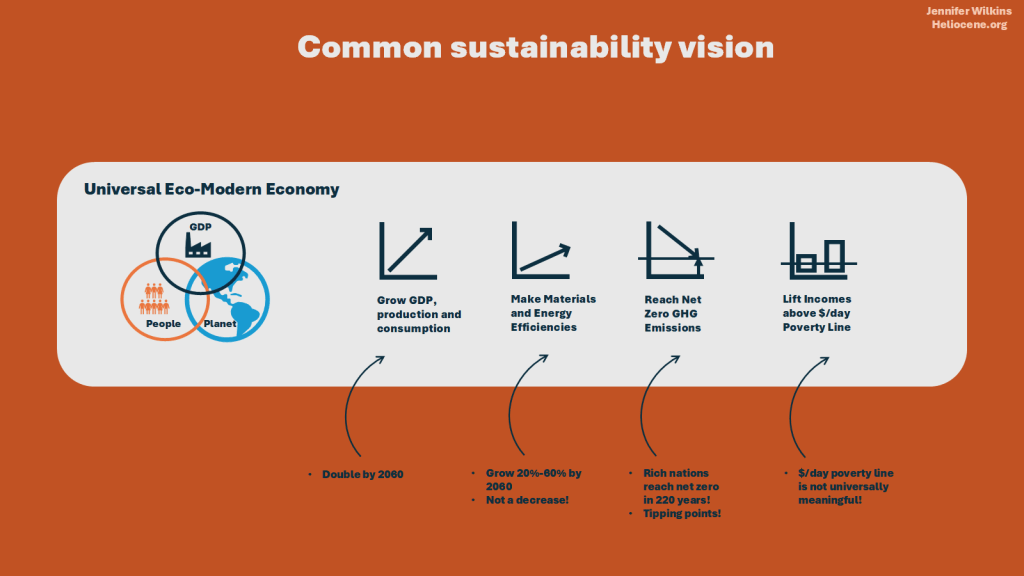
Assumption 1 is that the economy will grow. The UN and OECD assume GDP will at least double by 2060, an annual growth rate of 2%, which is very reasonable, under some scenarios, but not all.
Assumption 2 is that resource use will grow at a slower rate than GDP, due to efficiencies. Global resource use could grow from 100Gt per year today to between 120 and 160 Gt by 2060. These numbers are trends. They’re not targets aligned to planetary boundaries. To operate within PBs , resource use must reverse, because its responsible for 50% of GHG emissions and 90% of global water stress and biodiversity loss. In the 1970s, when we first noticed that nature was struggling, we were using 30Gt of resources per year.
Assumption 3 is that we’ll reach net zero within 2C this century by shifting to renewables and developing NETs. GDP grows and emissions fall – this is called decoupling. It is a theory. Rich nations are decoupling, but only very, very slowly. They will reach net zero in 220 years. This means another two centuries of net GHG emissions by rich nations and it’s unclear what lower income nations will achieve.
Assumption 4 is that every nation’s income per capita will grow so that relatively poorer nations rise above a poverty line. A rising tide lifts all boats. But even the most favourable convergence scenarios in the IPCC reports, for instance, show that poorer nations’ GDP per capita won’t reach the poverty line until near the end of the century.
The conclusion is that the eco-modernist vision for a sustainable economy does not adequately address climate, nature, poverty and inequality issues. As the opening plenary speaker said, this poses a massive risk to humanity.
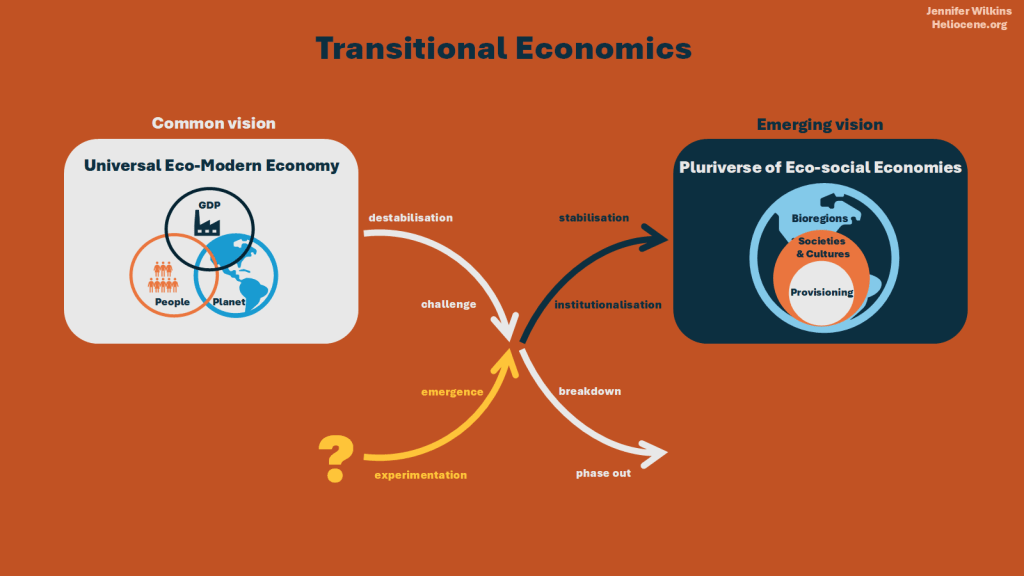
New economics is a precautionary approach to this risk, imagining alternatives to eco-modernism that address ecological and social concerns. Transitioning to a new economic paradigm is not linear. Old assumptions are replaced by new ones, along an X-curve.
Things to note:
•Firstly, we mustn’t decree a new global vision because that would be a new form of colonialism. It must be a pluriversal vision, not a universal vision.
•Secondly, the status quo is very powerful at co-opting and diminishing challenger ideas. A sandpit of transitional ideas (represented by the yellow “?” on the slide) is coalescing and converging on a highway of experimentation. These transitional ideas include Doughnut Economics, Indigenous Economics, Capabilities Economics, Ecological Economics, Wellbeing Economics, Degrowth Economics and Economy for the Common Good. Gareth Hughes of WEAll Aotearoa is doing tremendous work bringing these new economics together. And when I said Indigenous Economics that wasn’t singular. There are about 5,000 different Indigenous Economic systems around the world, so they are the majority economics.
•Thirdly, there are things we must leave behind, like neoliberalism, which is not compatible with eco-social economies. But there are existing ideas that will flow into this newly forming paradigm. Things like circular economy, resource efficiencies, renewable energy deployment and electrification.
One emerging new economics idea is degrowth. Degrowth is a proposition for providing wellbeing to all within planetary boundaries, a goal mentioned a few minutes ago by my fellow panellist Andrew Petersen from the Business Council for Sustainable Development Australia.
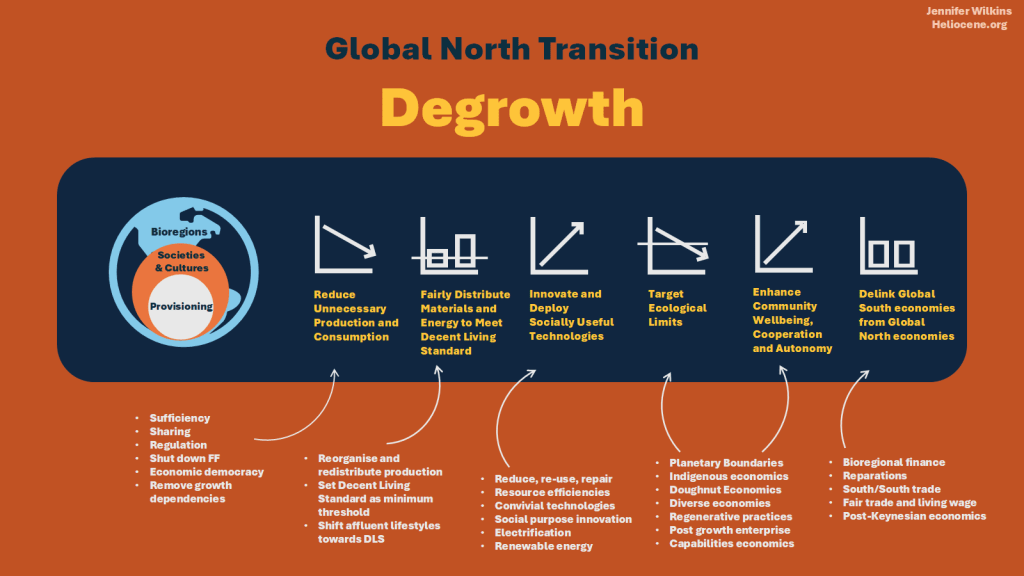
A number of assumptions are beginning to establish in the field.
Assumption 1 is that less-necessary types of production and consumption will stop. This involves shutting down fossil fuel extraction; limiting high impact consumption by the very rich, such as private yachts and private jets, and generally shifting affluent lifestyles towards a sufficiency-led approach to consumption.
Assumption 2 is a redistribution of resources so that everyone lives above a decent living standard and is provided with technologies and appliances and options that minimise our materials and energy use. Affluent people use 27 tonnes of resources per year and the world’s poorest use about 2 tonnes. The goal is for everyone to have at least 6 tonnes for a decent living standard. And the less energy we use, the faster we can shift to a renewable energy economy.
Assumption 3 is that innovation shifts from being about devices to being about social purpose, such as food sovereignty.
Assumption 4 is that we target coherent eco-social goals, including planetary boundaries, decent living standards and cultural autonomy, so that our action is holistic.
Assumption 5 is that degrowth applies only in affluent global north nations. Global south nations may delink from the global north, trading more with each other and regaining sovereignty over their resources and productive capacity to be able to meet their own needs.
So, this has been a very quick overview of degrowth assumptions, transitional economics and a critical look at the status quo. I hope this has helped generate some questions for the panel.
Ngā mihi nui.
Speech and slides end.

