Businesses need stability; capitalism creates chaos

Double materiality between climate and business is deepening in real time. A scan of past headlines tells of rising awareness, failing action and a capitalism increasingly unfit for the challenges it faces. If trends continue, businesses will inevitably transition to an alternative stabilising economic operating system, the shape of which is yet to be decided. … Continue reading Businesses need stability; capitalism creates chaos

Prosperous economic activity, not growth

Every time you read, write or begin to say the phrase “economic growth”, swap it out for the phrase “economic activity”. It will cause you to think differently about what is being suggested. You’ll ask: economic activity involving whom, using what, doing what, to create what, to achieve what, for whom, and why? These are … Continue reading Prosperous economic activity, not growth

A Post-Growth Nature-Positive Aotearoa

An Oct 2024 report by EY NZ and WWF NZ, A Nature Positive Aotearoa, argues that a rapid, major boost to nature protection would contribute to long-term net GDP growth. However, there’s much in the report to support further thinking through a degrowth/post growth lens. NZ is in crisis with 66% of native forest, 90% … Continue reading A Post-Growth Nature-Positive Aotearoa

The Ill Logic of Addressing Climate Change to Save Growth While Growth Destroys Nature

The current global economic growth model is increasingly at odds with the environmental and climate realities we face. Tackling climate change in growth settings will inevitably result in nature losses, which are not being adequately accounted for—a recent BCG report being a prime example. Climate change solutionism generates false optimism, perpetuating the idea that economic … Continue reading The Ill Logic of Addressing Climate Change to Save Growth While Growth Destroys Nature

When growth is an impediment to prosperity

In an age when economic growth is slowing in wealthy economies, New Zealand’s political and economic systems stay tethered to the promise of prosperity through growth—and falter when growth trickles out. Yet, when pursued blindly, growth can undermine the very prosperity we believe it should boost. It’s time for a national conversation about the rising … Continue reading When growth is an impediment to prosperity

Post-Growth Science Explained

The timing could not be sweeter for a new paper—Post-growth: the science of wellbeing within planetary boundaries—from the leaders of post-growth thinking, providing an overview of the current research. With concerns rising that economic growth in high income nations is not sustainable, socially beneficial or even economically achievable, post-growth research is centred on replacing the … Continue reading Post-Growth Science Explained

A Change in Building, By Design

Housing has become an expensive asset and a key pillar of capitalism, where profitability reigns—leaving some people in substandard homes or without a home at all. Instead, the building industry needs to see itself as part of a system for provisioning shelter—satisfying a human need—rather than a developer of housing as an asset. This shift … Continue reading A Change in Building, By Design

Social-ecological Movements

What is social-ecological thinking? How can social-ecological movements leverage change towards a sustainable economy? How can social-ecological drivers change the economy, eg the agri-food sector? These three macroeconomic questions are tackled in the presentation below, which contributed to a session at the 'Economy for Public Good' conference in Wellington, New Zealand, on 24 November 2024, … Continue reading Social-ecological Movements

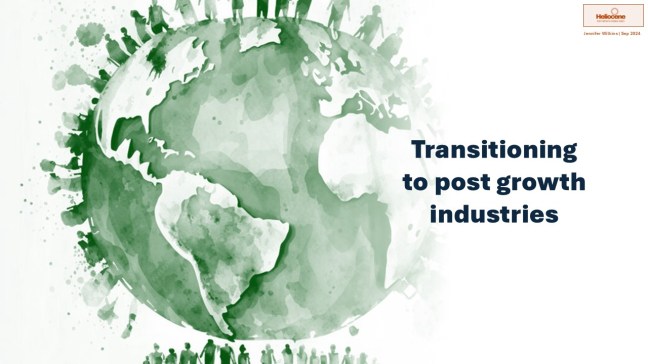
Transitioning to Post Growth Industries

It was such a privilege to be invited by WEAll Aotearoa to participate in a webinar on post growth business alongside two heroes of mine, Melanie Rieback, CEO/Co-founder of Radically Open Security, and Erinch Sahan, business and enterprise lead at the Doughnut Economics Action Lab. My thanks to Gareth Hughes, Sally Hett and Jessica Lavelle … Continue reading Transitioning to Post Growth Industries

NZCCBC24: Reflections through a Post-Growth Lens

The New Zealand Climate Change and Business Conference is targeted at business professionals working on climate issues. I was invited to present a post-growth economics and enterprise perspective in a panel on A Thriving Economy Within Planetary Boundaries. There was a flurry of social media posts during the conference, all positive, none challenging or critical. … Continue reading NZCCBC24: Reflections through a Post-Growth Lens

Transitional Economics

Great to speak to a packed room at the 2024 NZ Climate Change and Business Conference for a kōrero on “A Thriving Economy Within Planetary Boundaries”. Below is my 4-minute speech, which focused on the X-curve to move away from status quo economics towards an eco-social future economy, and the role of degrowth thinking in … Continue reading Transitional Economics

2024 Degrowth Conference: ‘Investing in Degrowth’ Session Summary

The field of degrowth and post-growth finance is in its nascent stages, with ongoing research and emerging practices. To advance the dialogue, a session on ‘Investing in degrowth: resourcing postgrowth futures’ took place at the joint 10th Intl. Degrowth Conference and 15th Conference of the European Society of Ecological Economics in Pontevedra, Spain, on 19 … Continue reading 2024 Degrowth Conference: ‘Investing in Degrowth’ Session Summary

Degrowth-aligned Investing

What role can investing play in a degrowth transformation of the economy? New Zealand's Impact Investing Network (IIN) has begun to explore the potential for funds managers to help engineer an economic system breakthrough, pinning a spotlight on the idea of degrowth-aligned investing. The IIN, a peak body dedicated to expanding the impact investing sector … Continue reading Degrowth-aligned Investing

We Need Degrowth Energy Scenarios

Degrowth responds directly to climate change and other sustainability and wellbeing issues, affecting energy and resource use. It is crucial not to overlook it when developing climate scenarios for the energy sector. The Aotearoa New Zealand Ministry of Business, Innovation and Employment (MBIE) has released Electricity Demand and Generation Scenarios, July 2024, reinforcing mainstream assumptions … Continue reading We Need Degrowth Energy Scenarios

Intro to Degrowth-aligned Finance

This presentation introduces degrowth-aligned finance in a webinar hosted by the Sustainable Finance Network of the Institute of Environmental Management and Assessment (IEMA), the largest professional body for environmental practitioners in the UK and worldwide. There's also a brief presentation by Adrian Vodislav, Structured Finance Officer of the European Investment Fund (EIF), discussing the EIF's … Continue reading Intro to Degrowth-aligned Finance

Kaupapa Māori Enterprises: Agents of Aspiration

In my recent Master's thesis for a degree in Degrowth: Ecology, Economics and Policy at the Autonomous University of Barcelona, I explored how kaupapa Māori enterprises contribute to achieving Māori aspirations. In settler colonial countries, Indigenous nations have faced systemic destruction through dispossession and de-culturalisation, eliminating traditional modes of production and value creation. Modern Indigenous … Continue reading Kaupapa Māori Enterprises: Agents of Aspiration

The Huge Water and Energy Costs of AI

Sustainability reports from Google and Microsoft indicate they are struggling on climate action, with both companies citing expansion of data centres for AI, which have high energy and water demands, coupled with a scarcity of renewable energy. Is AI so profitable they are willing to forego environmental goals? Or do they have no control over … Continue reading The Huge Water and Energy Costs of AI

Degrowth-aligned Finance

The briefing paper 'Degrowth-aligned Finance: A preliminary exploration' is an aid to understanding the emerging elements of a degrowth-aligned financial system. Co-authored by Jennifer Wilkins and Anastasia Linn, its purpose is to initiate conversations and encourage building a shared research and practice agenda. It also provides supporting information to the Special Session "Investing in Degrowth" … Continue reading Degrowth-aligned Finance

SLIM Lifestyles: Narratives for Climate Models

Narratives properly explaining the various approaches to sustainable lifestyles have been missing from climate modelling. Now, European researchers have developed the SLIM (Sustainable Living in Models) scenarios, offering four lifestyle narratives for long-term climate mitigation, designed to be easily incorporated into Integrated Assessment Models (IAMs). Previously, IAMs have used simplified assumptions (e.g. 100% vegan diets) … Continue reading SLIM Lifestyles: Narratives for Climate Models

The Heterogeneity of Affluence

There's a tendency in post-growth thinking to assume the global affluent are somewhat homogeneous. A study on global values reveals strong divergence, even in a modernising and globalising world, with the greatest divergence around emancipatory values. This has implications for advocating sustainability to affluent people around the world. Researchers Joshua Conrad Jackson and Danila Medvedev … Continue reading The Heterogeneity of Affluence